Daily life before averages
A neighbourhood is understood through travel, the services a household actually uses, public spaces, and the pace it wants.
Neighbourhood portrait
A central east Montréal borough known for its community and services.
Estimate my home →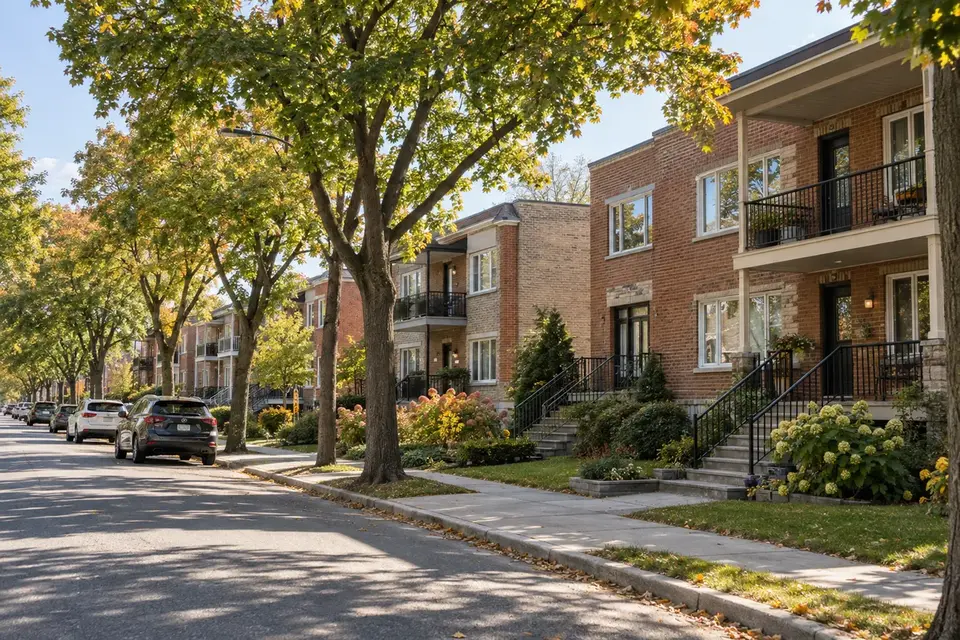
Understand the area
Saint-Léonard combines diverse housing, parks, municipal facilities, and commercial streets such as Jean-Talon East. A property decision should still begin with the exact address, building type, and the household’s daily needs.
Three ways to read the context
A neighbourhood is understood through travel, the services a household actually uses, public spaces, and the pace it wants.
Two properties in the same area can offer very different contexts. The street, block, and immediate surroundings matter.
Maps and portraits guide the search. A decision then requires checking the property, documents, and applicable rules.
Household and dwelling profile
The data covers Saint-Léonard and combines the Port-Maurice and Grande-Prairie housing-reference areas.
+1.1 % from 2016 to 2021
Share of owner households in 2021.
Before-tax income reported in the profile.
Median shelter cost: $890 per month.
Housing forms
These shares describe occupied dwellings; they are neither a sales distribution nor a price measure.
Ville de Montréal, 2021 Household and Dwelling Profiles, using Statistics Canada 2021 Census data.
Verified reference points
Every figure identifies its period, geography, and source. Changing market data stays on the Market page so the neighbourhood portrait is not confused with property-market trends.
Saint-Léonard territory using Montréal housing-reference areas.
Population shown in the borough’s official profile.
11 large parks and 9 mini-parks, plus recreation facilities.
Commercial corridor crossing the borough from east to west.
See and experience
The civic and recreation heart beside the borough hall, library, Martin-Brodeur arena, and aquatic complex.
View the official listing ↗In parc Pie-XII, this cave formed in ancient limestone can be visited seasonally through educational activities.
View the official listing ↗A corridor of shops, restaurants, and services reflecting the area’s cultural diversity.
View the official listing ↗The library offers collections, workshops, and intergenerational activities; the gallery adds visual arts to the civic hub.
View the official listing ↗Daily life
A neighbourhood is experienced street by street. These points help prepare a visit and verify what matters to your household.
Saint-Léonard combines homes, plexes, and multi-unit buildings in a relatively compact territory. The atmosphere changes between major corridors and interior streets.
Parks, shops, schools, and municipal facilities are numerous, but walkability varies by street pattern and the major roads that must be crossed.
The planned Blue Line extension is significant. Dates, construction, and future access should be followed through official communications.
Cultural diversity, associations, recreation, and civic places play an important role in Saint-Léonard’s identity.
Housing
Housing includes family homes, many plexes, and condominium or rental buildings. Each segment requires a different comparison approach.
A substantial share of residential development dates from rapid growth between the 1950s and 1970s. Maintenance and technical upgrades are therefore essential.
Lacordaire, Langelier, Viau, Jarry, and Jean-Talon structure the area. Noise, traffic, and access to shops can change quickly from one block to another.
Through the year
Dates, locations, and conditions change. Always check official programming before visiting.
Parc Wilfrid-Bastien hosts activities and performances in warmer months; programming changes each year.
Basketball, bocce, tennis, swimming, and drop-in activities are distributed across several large parks.
Workshops, clubs, talks, and exhibitions provide regular programming at the library and Galerie Port-Maurice.
Cave visits are seasonal and require checking conditions with the responsible organization.
Frequently asked questions
The parc Wilfrid-Bastien area groups the borough hall, library, arena, sports fields, and aquatic complex.
It crosses the borough, contains more than 240 shops and businesses according to the City, and serves as an economic and cultural corridor.
The extension is a project in progress, not an existing service. Consult official updates before factoring future access into a decision.
Separate houses, plexes, and condominiums, then align age, area, condition, parking, and micro-location. A broad average hides these differences.
Published data
Displayed data has passed source, period, geography, and quality controls. Missing data remains unavailable instead of being estimated or replaced with zero.
Housing-unit count published by the Ville de Montréal for the housing-reference areas composing the geography.
Sources and method
Method: missing or stale data is shown as unavailable and is never replaced with zero.
Home IQ
Connect the broad portrait with the actual context of the property you are considering.